

Why does dating suck?!
A dating analysis through the lens of current relationship buzzwords

If you spend even five minutes online, you’ll notice we’re living through a full-blown dating malaise. Every platform is diagnosing something: a “dating depression,” a “male loneliness epidemic,” the slow death of the talking stage. And the numbers don’t exactly make you feel more optimistic. Pew says only 30% of single women under 30 are actively dating, while men in the same age group are clocking in above 60%. Women describe dating as unsafe, exhausting, and unrewarding. Men say they feel anxious, disconnected, and unsure how to show up. Apps are losing engagement. First dates are down.
For men: one study found that 1 in 3 men aged 18 to 24 believes no one will ever fall in love with them. Another survey reported that over half of men think they don’t “stand a chance” on dating apps. For women: loneliness reports at just as high, and in some cases higher, rates. Studies from the Campaign to End Loneliness show that women under 30 are the loneliest age group and that women are often more chronically lonely than men.
In other words: no one feels particularly good about any of this.
But here’s the part I can actually speak to. I am a 26-year-old single woman living in New York, and dating right now feels less like a path to connection and more like a messy social experiment we’re all conducting at the same time..which is probably why we use vocabulary as a way to make chaos legible. He didn’t just disappear…he ghosted. He didn’t drift…he slow-faded. He didn’t flirt…he breadcrumbed. We name the behavior so it feels like something we can understand rather than something happening to us. Survival through semantics, as they say.
So here is the lay of the land, from a woman who has lived through most of these terms before and heard the rest from friends at 1 a.m. Below, a glossary of what dating looks like right now for both men and women, through the key terms we all know and love <3
1. Ghosting

Ghosting is the cleanest cut in modern dating. It’s both happened to me and I’ve done it (don’t judge me). It has always existed, but the digital world has turned it into a default exit strategy. Pew data shows that about 42% of people ages 18 to 29 have been ghosted, and newer research goes even further. One study reports that 84% of Gen Z and Millennials have experienced it, while almost 1 in 3 ghosters say mental health struggles influenced their decision. When disappearing takes one ignored text or an un-match, people choose ease over effort almost every time.
But, of course, a sudden silence creates a vacuum that fills with anxiety, overthinking, and self-blame, especially when the person who “vanished” is still posting pics on Instagram. It reflects a dating culture shaped by overstimulation and avoidance, where clarity feels optional and disappearing is framed as “protecting someone’s feelings” instead of dodging discomfort. Lately, though, some daters are trying to reverse the trend with the “anti-ghost text,” a short message that lets someone down gently instead of dropping off the planet. It’s basically a polite “I’m not feeling the spark,” and yes, I have always made my best friend draft mine. Dating is chaotic enough, and sometimes the smallest bit of honesty really is the kindest route. Treat others how you’d want to be treated!
2. Slow-fading
Slow fading is ghosting’s cousin. It’s intentional but gradual. Texts arrive hours later than they used to. Plans drift into the hypothetical. You’re not rejected, just stuck in a confusing middle space where nothing is said but everything is implied. And it’s surprisingly common. One survey found that 63% of daters have slow-faded someone, which tracks because the behavior feels “kinder” than disappearing outright.
Therapists say people rely on the slow fade because avoiding discomfort feels easier than having an adult conversation. They convince themselves they’re letting things “naturally fizzle,” even when they’re deliberately creating the fizzle. Research backs this up too — most slow-faders admit they do it to dodge awkwardness or conflict, and nearly 90% of young daters worry they’ll be “fizzled” instead of given a clear answer. Some even confess they keep the door cracked just in case they want to wander back through it later.
3. Love bombing
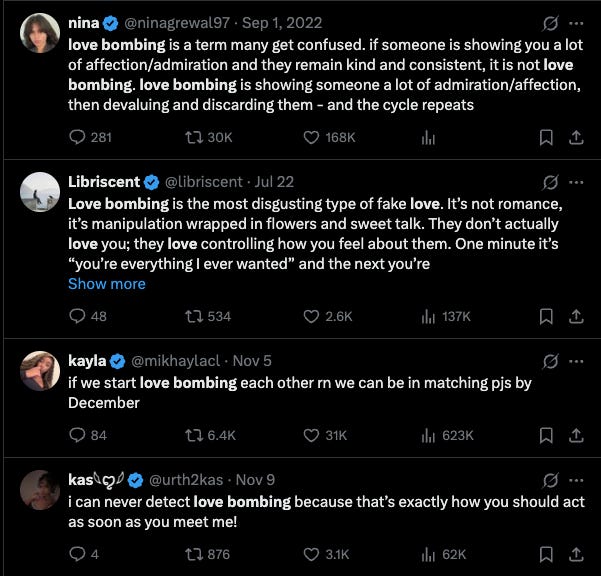
Love bombing is the opposite problem. Instead of pulling away, someone rushes in so fast it feels like you hit fast-forward on the relationship. While it can feel sooo nice it’s also not healthy. Surveys show nearly 70% of people say they’ve been love-bombed, and the number jumps even higher among dating-app users. Researchers link the behavior to insecure attachment styles and even narcissistic traits. The Crown Prosecution Service officially categorizes love bombing as part of coercive control because the pattern often moves from early idealization to jealousy and withdrawal.
Culturally, love bombing makes sense in a dating landscape where everyone is starved for connection. When so many early-stage interactions fizzle, that kind of enthusiasm can feel like proof that something real is happening. Even when we sense it’s too much too soon, the excitement is tempting. It feels good to feel wanted! Love bombing taps into the part of us that craves certainty, but it also shows how easily that craving can be manipulated.
4. Benching
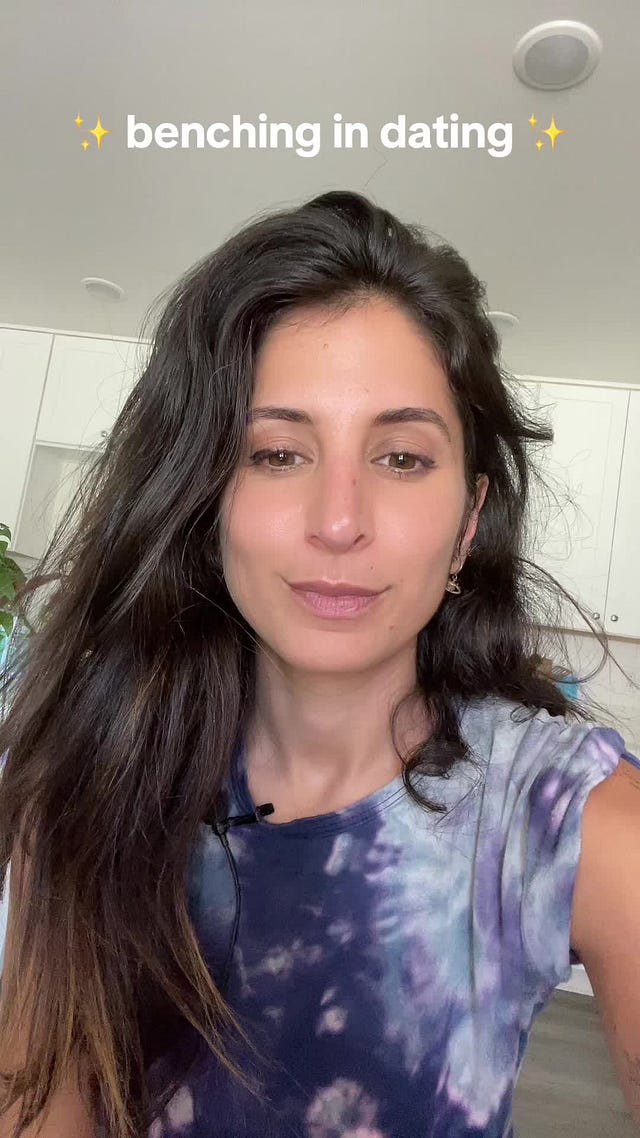
Benching is what happens when someone doesn’t want to date you but also doesn’t want to stop dating you. You get just enough attention to stay warm on the sidelines, but never quite lock in a real plan. Dating researchers say this is a direct byproduct of choice overload. When people feel like the apps offer an endless lineup, they’re more likely to keep multiple connections “simmering” rather than choosing one. Psychology Today even describes benching as treating people like “back-up inventory,” which sounds harsh but I guess fits.
 Tiktok failed to load.
Enable 3rd party cookies or use another browser
What makes benching so confusing is the pattern itself. Experts compare the inconsistency to intermittent reinforcement, the same psychological loop that makes gambling addictive, so one good night of texting can undo two weeks of distance. As a broader trend, benching reflects how dating has turned into a rotation system where everyone wants to feel chosen but no one wants to choose. I’m not here to give prescriptions, nor do I know literally anything, but therapists are pretty united on one idea: if someone’s effort doesn’t rock, they’re probably keeping you nearby “just in case,” not building something real.
5. Breadcrumbing
Breadcrumbing is dating’s version of “don’t leave… but don’t come too close either.” It’s the tiny, inconsistent crumbs of attention that keep you vaguely invested without anything actually progressing. A story react when you stop texting. A “we should hang soon” that never becomes a plan. A perfectly timed check-in right when you were ready to move on. Psychologists link this to intermittent reinforcement, the same reward pattern casinos use to keep people at slot machines. And the numbers are real… studies show more than 30% of young adults say they’ve breadcrumbed or been breadcrumbed in the past year, and victims report higher loneliness and lower life satisfaction than people who were simply rejected outright.
Dating apps make breadcrumbing easier than ever. When someone can swipe up ten new matches before their Uber arrives, certain people start treating connections like browser tabs they won’t close “just in case.” Hinge practically fuels this — you can toss someone a like without offering anything meaningful at all. Those little pings feel flattering in the moment, but over time they chip away at your standards until you’re grateful for crumbs instead of expecting consistency. Researchers even tie breadcrumbing to insecure attachment and vulnerable narcissism, which can feel on the nose. But, as a tweet I read the other day said, a breadcrumb trail usually leads nowhere.
5. Shrekking
Shrekking is one of those trends that started as a TikTok joke and then became a little too real. The idea is simple: you date someone you’re not fully attracted to because you assume they’ll worship the ground you walk on and therefore can’t hurt you. Creators joke on TikTok, “even my Shrek had the audacity to ghost.” Gagged.
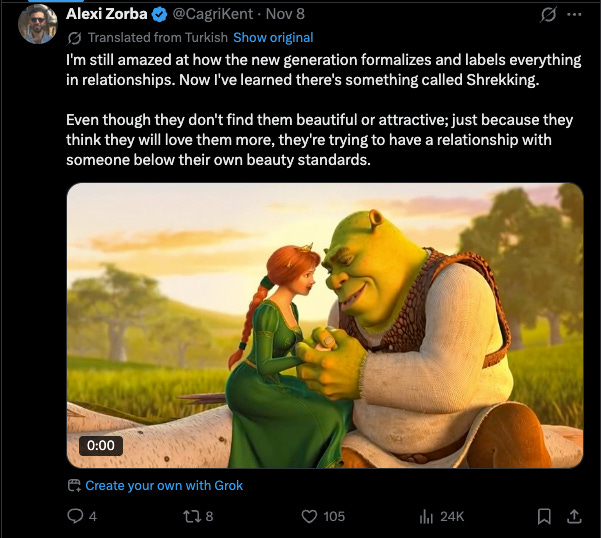
Psychologists say the behavior underneath is familiar. It mirrors what experts call “safety dating,” where people pick a low-risk partner out of fear, burnout, or the hope that someone “grateful to be chosen” will treat them better. There’s also real research on “mate value gaps,” where people choose partners they see as “safer” because they think it protects them from rejection.
But “dating down” doesn’t actually protect anyone. Attraction is not a hierarchy where picking someone “beneath your league” guarantees loyalty. People still flake, disappear, or underwhelm you, and then you’re left spiraling like, “I wasn’t even that into you, why am I upset?” Trend analysts say Shrekking took off because it spotlights how many of us are dating from fear instead of fun. It’s less about ogres and more about the illusion that we can hack heartbreak by lowering the stakes.
6. Nanoships
Nano-ships are the tiniest possible “relationships,” the ones that barely exist outside your imagination but still give you a tiny serotonin hit. Tinder’s Year in Swipe 2024 report (based on 8,000 singles across the US, UK, Canada, and Australia), says these “micro-connections” are on the rise because daters want small moments of warmth without the exhaustion of a full dating arc. Psychology Today describes them as quick sparks that come with zero expectations, like a barista remembering your order or a subway stranger making meaningful eye contact. They mimic that early-crush buzz without involving any vulnerability at all, which explains why they’re suddenly everywhere.
It makes sense, the low-stakes joy of a three-second interaction becomes enough to count. Experts caution that these tiny sparks can mimic intimacy and keep people busy with illusion instead of connection. Nanoships are cute and comforting, but they’re not supposed to replace dating entirely, apparently. My nanoship you ask? Jacob Elordi in Frankenstein.
7. Sidelined
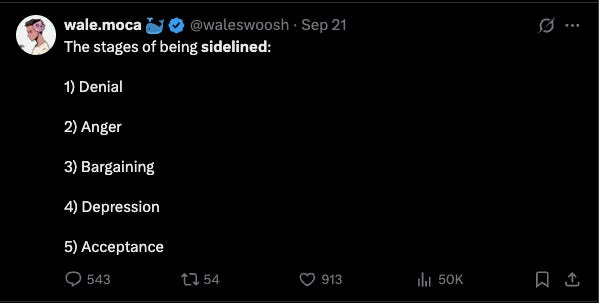
Being sidelined is exactly what it sounds like. You’re technically still in the game, but you’re not actually on the field. Someone keeps you nearby without committing to anything real. You get the check-ins. It feels warmer than ghosting and more involved than breadcrumbing, which makes it incredibly easy to rationalize. (“He wouldn’t text me this much if he wasn’t interested.” Girl, yes he would. It costs him nothing.) Researchers even have a name for this pattern: low-investment maintenance. The person is doing the absolute minimum to keep you around while they explore other options. Psychologists say it often comes from ambivalence or fear of choosing wrong, not some deep emotional attachment.
With endless matches and constant access to new people, attention has become something people redistribute rather than something they actually invest. It creates this extended limbo where multiple “maybes” float around because no one wants to make the wrong choice. Experts say the sideline exists as a way for people to avoid fully letting go without fully stepping in, which can leave the person on the receiving end feeling unsteady and stuck.
OMG this is my first time hearing about shrekking. DONE
I love shrek btw
Couldn’t have said it better myself!